
Two-Photon Polymerization Micro/Nano 3D Printer
Model: MicroFab-3D.S | Manufacturer: Microlight3D (France)
| Overview
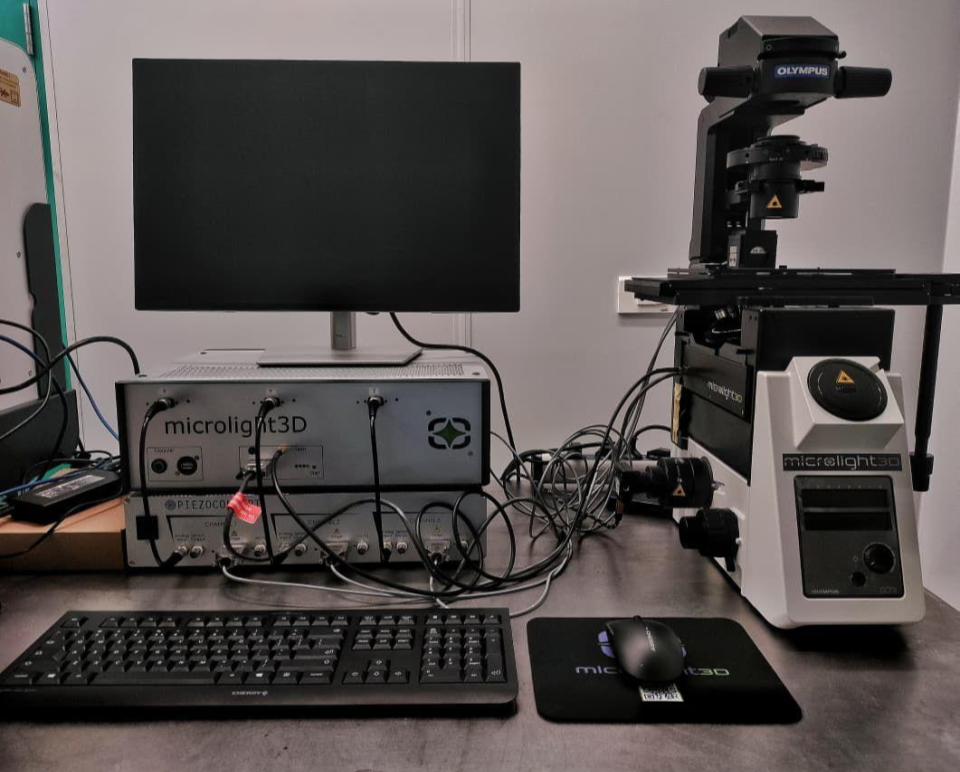
The MicroFab-3D.S by Microlight3D is an ultra-high-resolution additive manufacturing system based on two-photon polymerization. It enables true free-form 3D fabrication of complex micro- and nano-structures with sub-micron precision, supporting advanced research in micro-devices, optics, biomedical engineering, and functional materials.
| Key Features
Fabrication Technology
Two-Photon Polymerization (2PP) using a femtosecond laser – This non-linear optical process enables polymerization only at the laser focal point. It allows true free-form 3D fabrication with sub-micron resolution and no support structures.
Laser Source
Ultrafast femtosecond pulsed laser – The laser delivers extremely short pulses, ensuring high peak intensity with minimal thermal effects. This enables precise voxel control and high-fidelity micro- and nano-scale structures.
Laser Wavelength
532 nm (green laser) – The wavelength is optimized for efficient two-photon absorption in photopolymer resins. It supports high-resolution writing and stable polymerization conditions.
Minimum Feature Size
Down to ~200 nm (0.2 µm) – Feature size depends on objective lens, resin, and writing parameters. This capability enables fabrication of ultra-fine micro- and nano-structures.
Positioning Accuracy
Nanometer-scale positioning precision – High-precision nano-stages and galvo scanners ensure accurate beam placement. This guarantees excellent dimensional accuracy and repeatability.
Writing Mode
True 3D volumetric laser writing – Structures are written directly inside the resin volume, not layer-by-layer. This allows complex geometries, overhangs, and internal cavities.
Scanning System
High-speed galvo scanners with precision translation stages – The combined scanning system enables fast writing with accurate stitching. It supports both small high-resolution areas and extended fabrication zones.
Build Volume
Configurable; stitching area up to ~100 × 75 mm² – High-resolution writing is performed locally, with large areas achieved via stitching. Maximum object height can reach up to 20 mm (configuration dependent).
Materials Compatibility
Proprietary photopolymer resins (standard, functional, biocompatible) – Supports rigid, flexible, and bio-compatible materials. Enables research across optics, mechanics, and biomedical domains.
Applications
Micro-optics, microfluidics, MEMS, metamaterials, biomedical scaffolds, sensors, and micro-robotics. Suitable for advanced research in micro-devices and functional materials. Widely used in academic and industrial R&D environments.